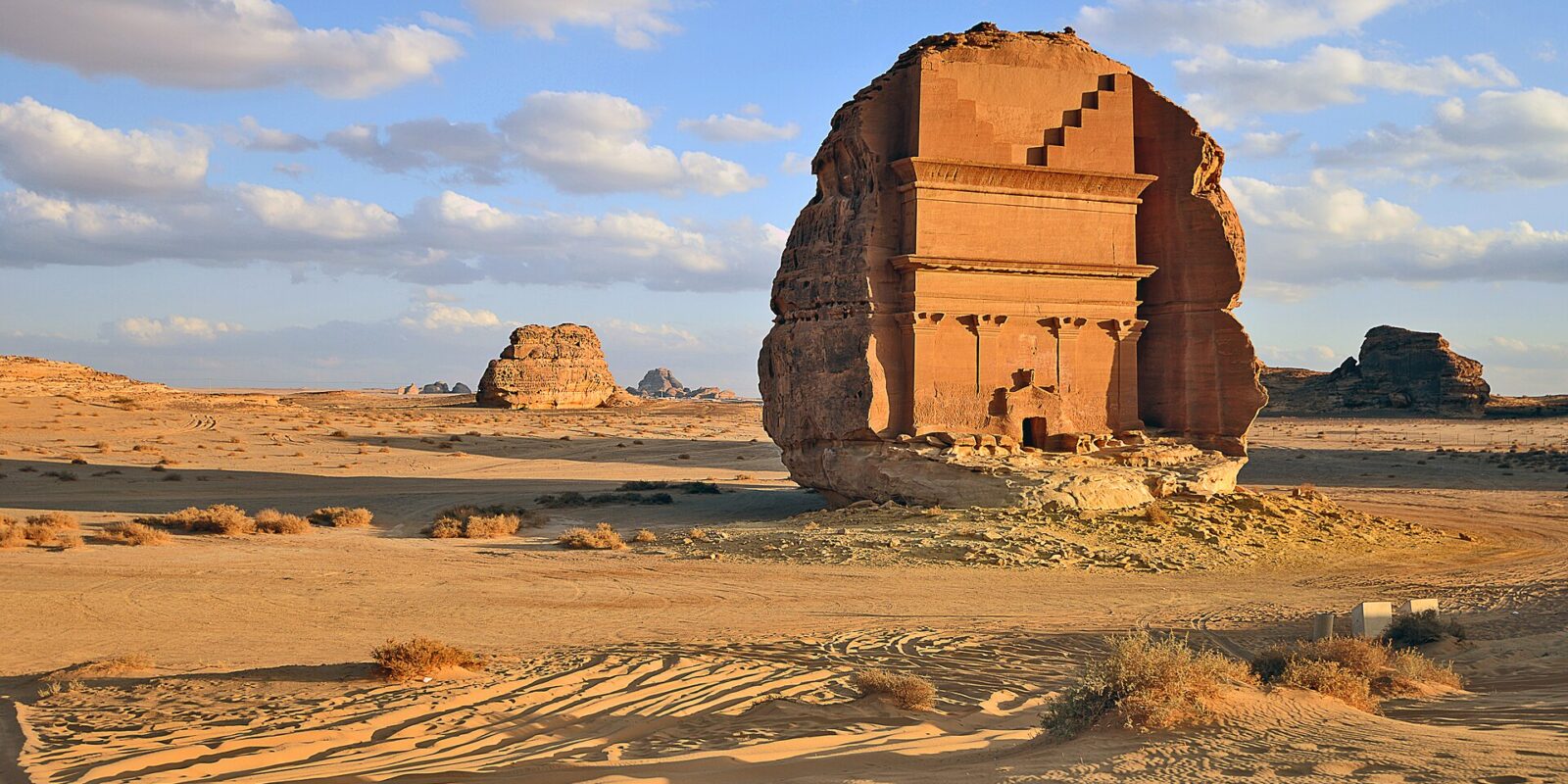
The Hegra tombs are the reason most people fly to AlUla: 111 monumental Nabataean tombs carved into desert sandstone, 94 of them with decorated facades, cut roughly between the 1st century BCE and the 1st century CE. If you have searched “hegra tombs” hoping to know what you will actually see, here is the quick answer: a handful of named, standout tombs (Qasr al-Farid, Jabal al-Banat, Jabal al-Ahmar) plus the sacred rock-cut spaces around Jabal Ithlib. I visited on a standard day tour, and this guide walks you through each cluster, what makes it special, and how to spot it from the coach.
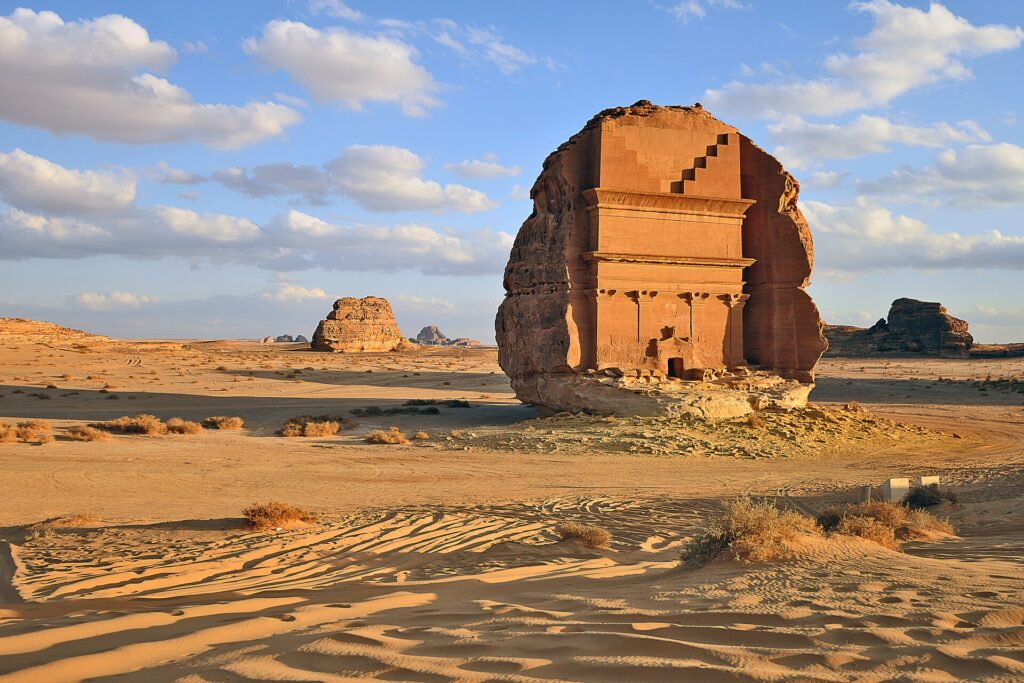
Quick answer: the most famous of the Hegra tombs is Qasr al-Farid, the giant “Lonely Castle” standing by itself on the plain. But the densest, most photogenic wall of Hegra tombs is Jabal al-Banat, and the atmosphere peaks at the Diwan near Jabal Ithlib.
In this guide
- What you’ll actually see at the Hegra tombs
- Qasr al-Farid: the Lonely Castle
- Jabal al-Banat: the mountain of the daughters
- Jabal al-Ahmar and the hidden tomb
- Jabal Ithlib and the Diwan
- How to read a Nabataean facade
- How to see the Hegra tombs on a tour
- When to visit the Hegra tombs
- Practical tips for visiting the Hegra tombs
- Frequently asked questions
What you’ll actually see at the Hegra tombs
First, set your expectations. The Hegra tombs are spread across a wide desert basin, not clustered in one gorge like Petra. You move between rock outcrops by coach, hopping off at four or five stops, and each outcrop carries anywhere from one to nearly thirty carved facades.
You do not go inside most of them. The Nabataeans hollowed out burial chambers behind each facade, but access is restricted to protect them, so the experience is about reading the exteriors, the inscriptions, and the setting rather than crawling into chambers.
Most tours start at the Hegra Visitor Centre, where a short introduction sets up the history before you board the coach. The guides here are trained storytellers, and a good one changes the visit completely; they turn what could be a row of weathered rock faces into individual family stories. If your group draws a flat guide, do not be shy about asking direct questions at each stop.
Of the 111 monumental tombs, 94 have decorated facades. That decoration is the whole point: crow-step crenellations, half-pediments, columns and carved creatures that tell you the status of the family buried inside. The plainer, undecorated tombs belonged to people who could not afford a sculptor.
Hegra became Saudi Arabia’s first UNESCO World Heritage Site in 2008, and that status shapes your visit. Numbers are capped, you go with a licensed guide, and you cannot simply wander off across the sand to a tomb that catches your eye. If you want the deep background before you go, our history of Hegra explainer covers how the Nabataeans built this trading city.
The named clusters below are the ones every tour hits. Learn these four or five names and you will understand ninety percent of what the Hegra tombs have to offer.
Qasr al-Farid: the Lonely Castle
Qasr al-Farid is the single image that sells AlUla, and it deserves its fame. The name means “the Lonely Castle,” and the tomb earns it: while most Hegra tombs huddle in clusters on shared outcrops, this one stands completely alone on an open plain, carved from one enormous boulder.
Its formal name is the Tomb of Lihyan son of Kuza. At roughly 22 metres (72 feet) tall, it is the largest of all the Hegra tombs. Stand at its base and the scale is genuinely hard to process in photographs.
Two details make it unmissable. First, it is unfinished: look at the lower third of the facade and you can see rough, unpolished rock and chisel marks where the carvers stopped. The Nabataeans worked top-down, so the crisp upper section and rough base freeze the construction mid-process.
Second, the facade has four pilasters (the flat, column-like uprights) instead of the usual two you see on every other tomb at Hegra. Nobody knows for certain why. The extra width may reflect the ambition of a wealthy patron whose grand plan was never completed.
Because it sits alone, Qasr al-Farid is usually the first or last stop, and it is the best spot for a wide photograph with nothing else in the frame. Late afternoon light turns the sandstone deep amber. If you are weighing AlUla against Jordan, our AlUla vs Petra comparison digs into how the two Nabataean cities differ, and Qasr al-Farid is exactly the kind of monument Petra cannot match for isolation.
Jabal al-Banat: the mountain of the daughters
If Qasr al-Farid is the poster, Jabal al-Banat is the wall of tombs you actually stand in front of longest. The name translates roughly as “the mountain of the daughters,” and it holds around 29 carved tomb facades packed onto one sandstone massif, making it one of the densest concentrations among all the Hegra tombs.
This is where the decorative language of the Hegra tombs is easiest to read side by side. Because so many facades sit together, you can compare crow-step tops, eagle carvings, urns and rosettes across neighbouring tombs and see how families borrowed and competed with each other’s designs.
Several of the Jabal al-Banat facades are among the best preserved at the site, with sharp crenellations still crowning the tops. Guides often point out the ones attributed to women, which is where the “daughters” nickname comes from, though the attribution is a modern reading rather than proven fact.
Practically, Jabal al-Banat is where I spent the longest and shot the most photos. Walk the full length of the outcrop rather than staying at the drop-off point; the facades wrap around the rock and the quieter faces are often the finest of the Hegra tombs.
Jabal al-Ahmar and the hidden tomb
Jabal al-Ahmar means “the Red Mountain,” and it holds 18 catalogued tombs dated to roughly 16 to 61 AD. On its own that makes it a solid stop, but it has one story that stands out among all the Hegra tombs.
After heavy rains in 2014, a shifting sand dune revealed a completely undisturbed tomb here, its contents untouched since antiquity. Discoveries like that are why archaeologists still work the site and why access across the Hegra tombs is controlled so tightly.
Not every tour lingers long at Jabal al-Ahmar, and on a busy day it can feel like a quick photo stop. If your guide is good, ask about the 2014 find; it is the moment the abstract history of the Hegra tombs becomes tangible.
Jabal Ithlib and the Diwan
Not everything at Hegra is a tomb. The area around Jabal Ithlib is the spiritual heart of the site, and for many visitors it is the atmospheric high point of a trip through the Hegra tombs.
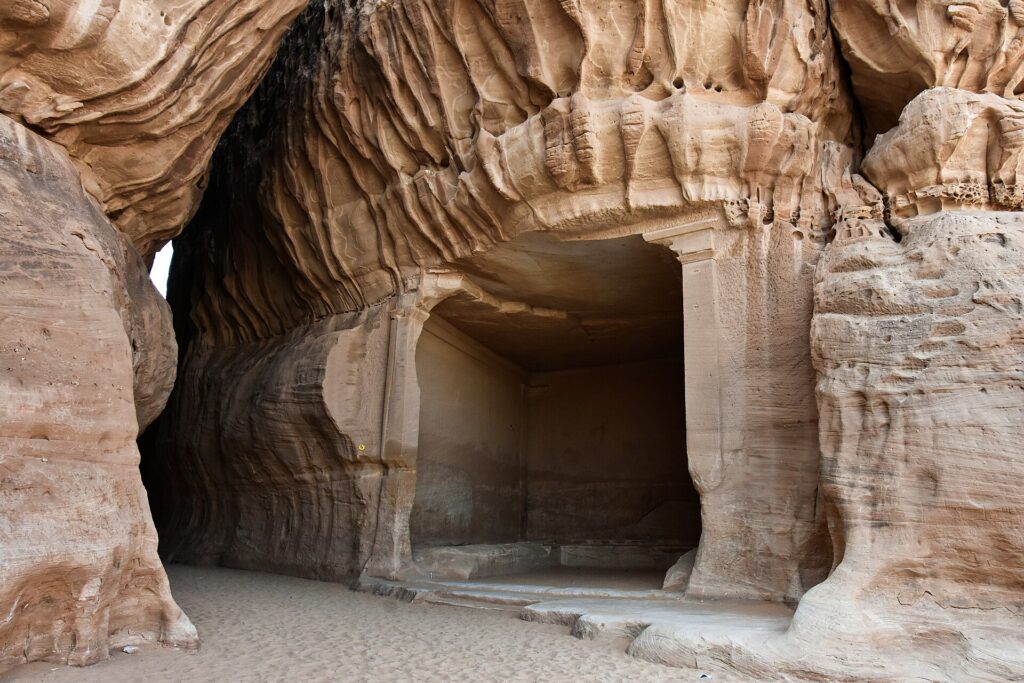
Here the Nabataeans cut a triclinium, a three-sided banquet hall, straight into the rock. This is the Diwan: a large open-fronted chamber where elite or ritual feasts were held, most likely to honour Dushara, the chief Nabataean god. Step inside and the temperature drops; the acoustics change; it feels different from the open tomb fields.
Beside the Diwan runs the Siq, a narrow natural corridor between towering rock walls, lined with carved niches and small shrines. It is a short, easy walk and an obvious echo of Petra’s more famous Siq, on a smaller and quieter scale. Look up as you walk it: the niches once held betyls, plain standing stones that represented gods without depicting them, a very Nabataean idea.
Because Jabal Ithlib is a walking stop rather than a drive-by, it also gives your legs a break and your camera a change of subject after a morning of facades. On hotter days the shaded passage is the coolest spot on the whole route.
If you only have time to slow down at one non-tomb stop while touring the Hegra tombs, make it Jabal Ithlib. The combination of the Diwan, the Siq and the carved sanctuaries gives you the religious side of a culture you otherwise meet only through its graves.
How to read a Nabataean facade
Once you have seen a few of the Hegra tombs, the facades start to make sense as a visual language. A little decoding makes every stop richer.
Motifs and carvings to look for
The carvings blend influences from across the ancient world: Nabataean, Greco-Roman, Egyptian and Assyrian motifs sit together on the same rock. Look for eagles (a symbol of protection), griffins, sphinxes, faces and urns crowning the pediments.
The stepped, staircase-like shapes along the tops are called crow-steps or merlons, and they are the signature silhouette of the Hegra tombs. The more elaborate the crown, the higher the status of the family.
Inscriptions and curses
Many facades carry inscriptions above the doorway. Some simply name the owner, but a striking number contain curses, legal warnings against anyone reusing the tomb or disturbing the dead, often threatening fines or divine punishment. These inscriptions are how researchers date the tombs and reconstruct Nabataean law.
Look, too, at the state of completion. Like Qasr al-Farid, several Hegra tombs are unfinished, and the rough patches reveal exactly how the carvers worked from the top down.
How to see the Hegra tombs on a tour
You cannot drive yourself in. Access to the Hegra tombs is only by official guided tour departing from the Hegra Visitor Centre or Winter Park, booked in advance through Experience AlUla. Independent wandering is not allowed, which protects the site but means you should book ahead, especially in the cooler tourist season.
The standard option is a shared coach day tour that hits the main clusters. There are also hop-on hop-off buses, wildlife tours, premium 4×4 trips and after-dark experiences. For a full breakdown of every ticket type and what each includes, see our dedicated Hegra tickets and prices guide, and for the logistics of getting to AlUla itself, our how to visit Hegra walkthrough covers flights and transfers.
Here are the core options and approximate starting prices at the time of writing. Always confirm live prices when you book, as seasonal tours come and go.
| Tour option | Approx. starting price (SAR) | Typical duration | Best for |
|---|---|---|---|
| Hegra day tour (shared coach) | from 95 | 2 to 3 hours | First visit, main tombs |
| Hegra hop-on hop-off | from 150 | 1 to 3 hours | Flexible, self-paced stops |
| Premium 4×4 tour | higher, varies | around 2 to 3 hours | Small groups, comfort |
| Hegra after dark | varies seasonally | evening | Atmosphere, lighting |
Prices start from around SAR 95 for the shared day tour and from about SAR 150 for the hop-on hop-off, both booked through Experience AlUla. Tours run in English and Arabic, and you should arrive at least 15 minutes before departure. The Hegra tombs sit about 20 to 25 minutes’ drive from AlUla old town, so factor in transfer time on top of the tour itself.
If you are building a wider itinerary, the Hegra tombs pair naturally with Dadan, Jabal Ikmah and the oasis; our roundup of things to do in AlUla sets out how to slot them into two or three days.
When to visit the Hegra tombs
Timing matters more here than at most sights, because the desert basin has almost no shade. The comfortable season runs roughly November to March, when daytime temperatures are pleasant and the light stays soft for longer; this is also peak season, so slots for the Hegra tombs book out well ahead.
From April through October the middle of the day gets genuinely punishing. If you visit in the warm months, take the earliest departure you can and treat an evening or after-dark option as a serious alternative rather than a gimmick.
For photography, the golden hour after sunrise and before sunset is when the sandstone of the Hegra tombs glows deepest. Qasr al-Farid faces in a way that rewards late-afternoon light, so if that single monument is your priority, aim for a departure that reaches it near the end of the day.
Practical tips for visiting the Hegra tombs
A few honest, learned-the-hard-way notes for making the most of the Hegra tombs.
- Go early or late. The site is exposed with almost no shade, and midday between spring and autumn is brutal. Early morning and late afternoon are cooler and give far better light on the sandstone.
- Book in advance. Because numbers are capped and you must go with a guide, walk-up availability is not guaranteed. In peak season (roughly November to March) popular slots sell out.
- Wear proper shoes and bring water. You will walk on sand and uneven ground between the Hegra tombs. Closed shoes and a hat make a real difference.
- Manage your expectations on going inside. Most tomb chambers are closed to entry. If getting into a tomb interior matters to you, ask your operator which current experiences, if any, include interior access, as this changes.
- Give the Diwan and Jabal al-Banat the most time. If your tour is flexible, these two stops reward lingering more than a quick drive-by of an isolated facade.
Recap: among the Hegra tombs, Qasr al-Farid is the giant lone monument, Jabal al-Banat is the dense photogenic wall, Jabal al-Ahmar hides the untouched 2014 discovery, and Jabal Ithlib with its Diwan is the sacred core. Learn those names and the Hegra tombs make sense.
Frequently asked questions
Can you go inside the Hegra tombs?
For the most part, no. The Nabataeans carved burial chambers behind each facade, but access to the interiors of the Hegra tombs is heavily restricted to protect them. Standard tours focus on the exteriors, inscriptions and setting. If interior access matters, check current experiences with Experience AlUla before booking, as availability changes.
How many tombs are there at Hegra?
Hegra has 111 monumental tombs, 94 of them with decorated facades, carved roughly between the 1st century BCE and the 1st century CE. Tours visit the main named clusters rather than all of them, so on a typical day you will closely see a few dozen of the Hegra tombs across four or five stops.
What is the most famous of the Hegra tombs?
Qasr al-Farid, the “Lonely Castle,” officially the Tomb of Lihyan son of Kuza. At about 22 metres tall it is the largest of the Hegra tombs, it is unfinished, and it stands alone on an open plain with four pilasters on its facade instead of the usual two.
How much does it cost to see the Hegra tombs?
At the time of writing, a shared coach day tour starts from around SAR 95 per person and a hop-on hop-off ticket from around SAR 150, both booked through Experience AlUla. Prices vary by season and tour type, so confirm live rates when you book.
How long do you need at Hegra?
A standard day tour of the Hegra tombs runs about two to three hours including transfers. That is enough for the headline clusters. If you want to slow down at Jabal al-Banat and the Diwan or shoot photography in good light, allow half a day and pick an early or late departure.