If you’re figuring out how to visit Hegra, here’s the short version: you book a timed, guided tour in advance through Experience AlUla, travel to AlUla by flight or car, and let an official Rawi guide walk you around Saudi Arabia’s first UNESCO World Heritage Site. You cannot self-drive inside the archaeological zone. I went on a cool February morning and it remains one of the most quietly overwhelming places I have stood in anywhere. This guide covers exactly how to visit Hegra in 2026 — tickets, tour types, real SAR prices, getting there, the best season, and the practical details nobody mentions before you go.
In this guide
- How to visit Hegra: the quick answer
- Why Hegra is worth the effort
- Getting to AlUla first
- How to visit Hegra: booking your tour
- Hegra tour options and prices
- What you’ll see on a Hegra tour
- Best time to visit Hegra
- Practical tips for how to visit Hegra
- How to visit Hegra on a budget vs in style
- A quick recap: how to visit Hegra
- Frequently asked questions
How to visit Hegra: the quick answer
Here is how to visit Hegra in three steps. First, book a Hegra Day Tour in advance on the official Experience AlUla website; it runs year-round and starts from around SAR 95 per person. Second, get yourself to AlUla, either by a short domestic flight into AlUla International Airport (ULH) or a road trip from Medina, Jeddah or Riyadh. Third, arrive at the Hegra South Gate meeting point at your booked time, where a guide and shaded coach take over.
That is the whole model of how to visit Hegra. There is no ticket booth you can just walk up to and expect a slot, and there is no self-drive option once you are inside. Everything below expands on how to visit Hegra properly so your one shot at this 2,000-year-old Nabataean city is not wasted on logistics.
Why Hegra is worth the effort
Hegra, also called Madain Salih, was the southern capital of the Nabataeans, the same civilisation that carved Petra in Jordan. In 2008 it became Saudi Arabia’s first UNESCO World Heritage Site, and it only opened to international tourists in 2020, so you are visiting somewhere that spent millennia essentially closed. That rarity is why so many travellers now research how to visit Hegra before anything else in Saudi Arabia. There are more than 100 monumental tombs cut into golden sandstone outcrops, many with facades so sharp they look machined rather than hand-carved.
What sets it apart from Petra is space and silence. Where Petra can feel like a procession, Hegra is capped at a limited number of visitors per day. On my tour there were long stretches where I could hear nothing but wind. If you are still weighing it up, I have a fuller argument in our piece on whether Hegra is worth visiting, but my honest answer is yes, comfortably, provided you get the logistics right.
The trade-off is exactly that logistics tax. You cannot wander in on your own schedule, tours sell out in high season, and AlUla is genuinely remote. Understanding how to visit Hegra ahead of time is the difference between a smooth morning and a frustrating one.
Getting to AlUla first
Before any conversation about how to visit Hegra, you have to reach AlUla itself, because the site sits about 22 km north of AlUla’s old town in a remote corner of northwest Saudi Arabia. There is no train and no way to shortcut the distance.
The easiest route is flying. AlUla International Airport (ULH) receives regular domestic flights, with roughly 11 flights a week from Riyadh on flynas and Saudia and an average flying time of about 1 hour 55 minutes. Saudia has also announced a direct Jeddah–AlUla route starting in 2026, which will make the western approach far simpler. From the airport it is a short 20–35 minute drive to most AlUla hotels.
Driving is the other option, and it is a serious undertaking. Medina is the nearest major city at roughly a three-hour drive, which is why many travellers fly into Medina and drive up. Jeddah is around 5–6 hours by road, and Riyadh is a long 9–11 hour haul across desert. If you would rather not do it yourself, our guide on getting from Jeddah to AlUla breaks down the coach, private-transfer and self-drive choices in detail.
| From | By air | By road |
|---|---|---|
| Medina | No direct flight | ~3 hours |
| Riyadh | ~1h 55m (≈11 flights/week) | ~9–11 hours |
| Jeddah | Direct route from 2026 | ~5–6 hours |
| AlUla airport (ULH) to hotels | — | ~20–35 min |
Once you are based in AlUla, getting to the Hegra meeting point is easy: there is free parking at the Hegra South Gate, or you can catch the connecting coach from Winter Park in the town centre. Either way, you are handed off to the official tour from there, which is the simplest leg of how to visit Hegra.
How to visit Hegra: booking your tour
The single most important thing to understand about how to visit Hegra is that it is a timed, guided visit and not a drive-up attraction. You reserve a specific departure slot in advance, show up at the meeting point, and travel between the protected tomb clusters on the tour vehicle. Self-driving inside Hegra is not permitted, and you are asked to stick to the marked walking paths and stay out of the tombs themselves.
Book through Experience AlUla, the official destination gateway. Because each day has a capped number of departures, pre-booking is strongly recommended — in the December-to-March peak, slots genuinely disappear. Buying at the visitor centre on the day is technically possible subject to availability, but I would not gamble a long trip on it.
The booking flow is simple: pick your date, choose the Hegra Day Tour or the private Premium Tour, select a time, and pay online. Children four and under go free. Cancellations made three or more days ahead are refundable, rebooking is possible one to three days out, and same-day cancellations are not refunded, so lock in a date you are confident about. For a deeper breakdown of every ticket category and add-on, see our dedicated guide to Hegra tickets and prices. Getting this step right is most of how to visit Hegra without stress.
Hegra tour options and prices
There are two core products, plus seasonal extras. Knowing the difference is a big part of how to visit Hegra without overpaying or under-booking.
The Hegra Day Tour is the standard, best-value choice. It is a shared, coach-based experience led by a local Rawi (storyteller-guide), runs year-round, lasts about three hours including transfers, and starts from around SAR 95 per person. Bottled water is included. This is what most visitors take and what I would recommend for a first trip.
The Hegra Premium Tour is a private 4×4 experience for up to seven people, lasting roughly two hours and starting from around SAR 1,000 per vehicle. If you are a family or small group and split the cost, it becomes reasonable, and you get a private guide and a more flexible pace. A Hegra by Horse Carriage option also runs seasonally when available.
During the winter season Experience AlUla sometimes adds a hop-on hop-off format with a multimedia guide device, which has been offered from around SAR 150 per person. Prices and formats shift each season, so treat these as guide figures and confirm live at checkout. Whichever you pick, how to visit Hegra comes down to booking the right slot for your group.
| Tour | Format | Duration | Price (from) |
|---|---|---|---|
| Hegra Day Tour | Shared coach + guide | ~3 hours | SAR 95 / person |
| Hegra Premium Tour | Private 4×4 (up to 7) | ~2 hours | SAR 1,000 / vehicle |
| Hop-on hop-off (seasonal) | Multimedia guide | From ~1h | SAR 150 / person |
| Children 4 & under | Any | — | Free |
What you’ll see on a Hegra tour
A standard tour stops at the site’s headline clusters, and a good Rawi turns each into a story rather than a photo stop. This is the payoff for all the planning around how to visit Hegra.
Tomb of Lihyan son of Kuza (Qasr al-Farid)
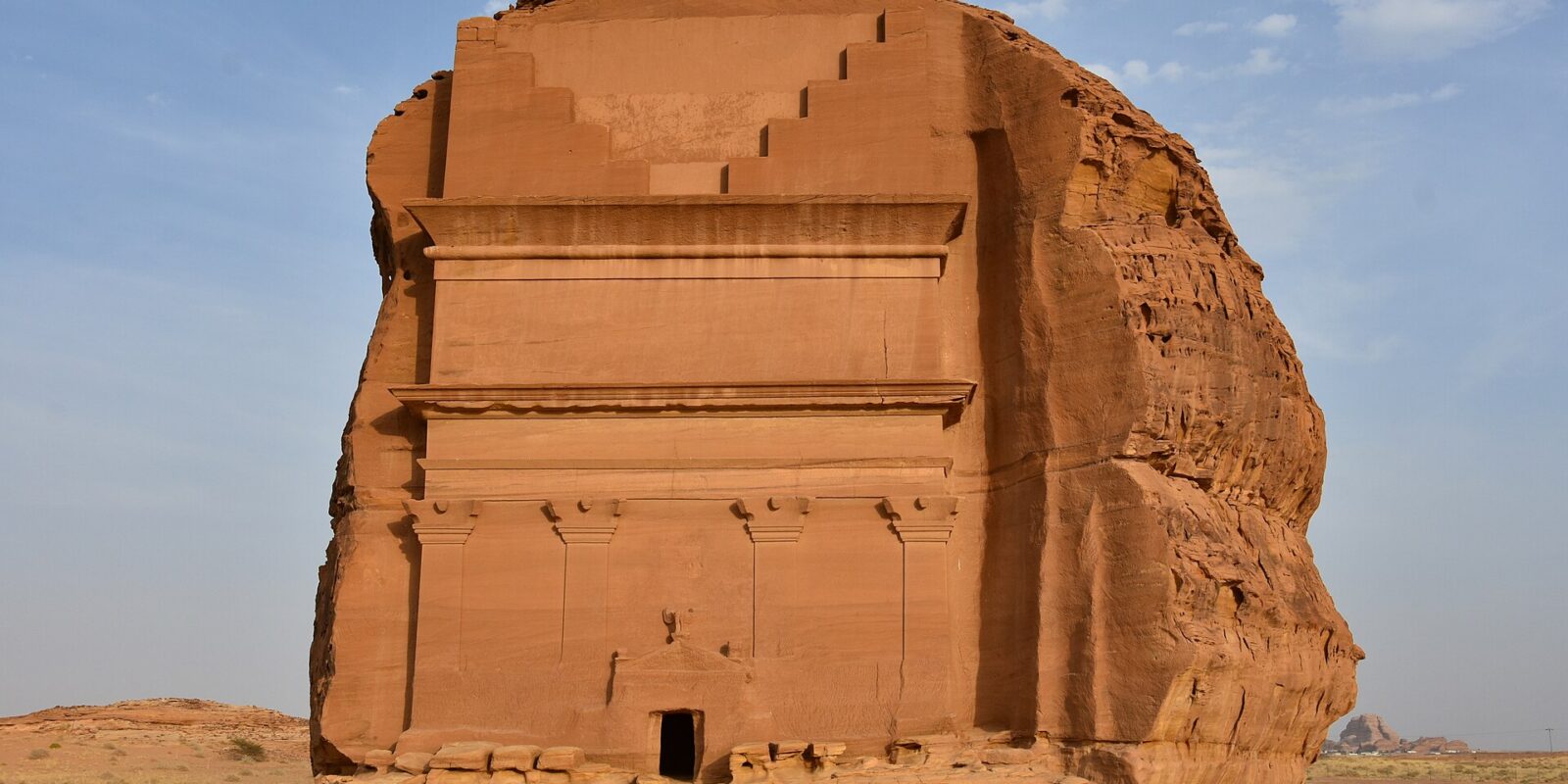
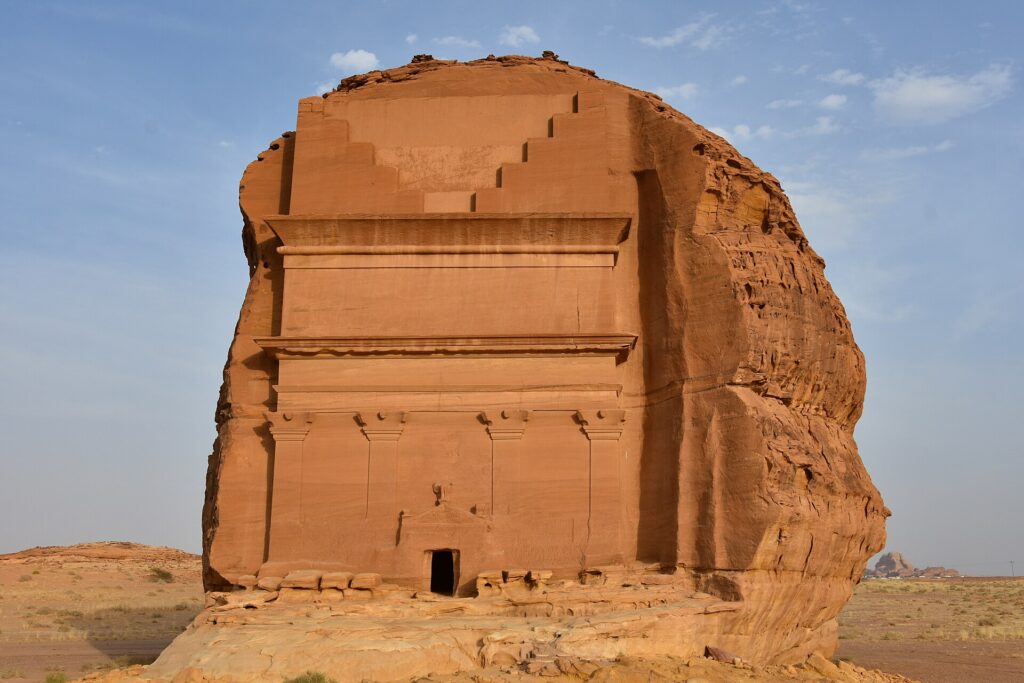
This is the icon: a single, freestanding sandstone outcrop carved on all sides into one enormous unfinished tomb, often called the “Lonely Castle.” It is the image most people picture when they imagine Hegra, and standing beneath its roughly 22-metre facade is the moment the scale of the place lands. If tombs are what draw you, our guide to the Hegra tombs goes cluster by cluster.
Jabal Ithlib and the Diwan
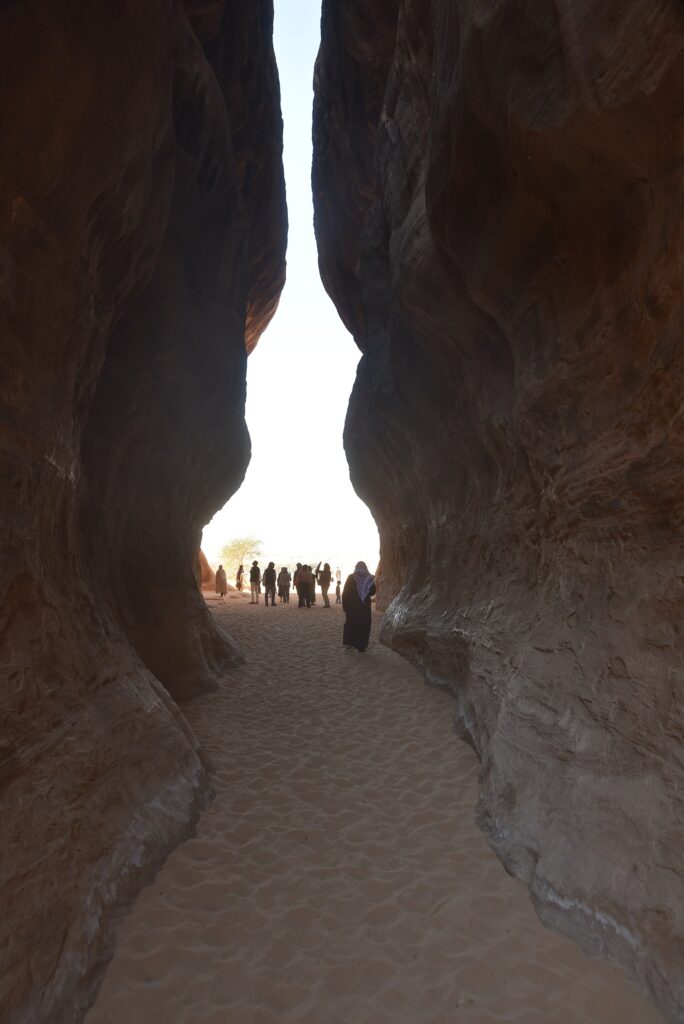
A natural rock corridor, the Siq-like passage of Jabal Ithlib, leads to the Diwan, a chamber the Nabataeans used for gatherings and ritual. It is a change of texture from the open tomb fields and one of the most atmospheric corners of the site.
Jabal Banat and Jabal Ahmar
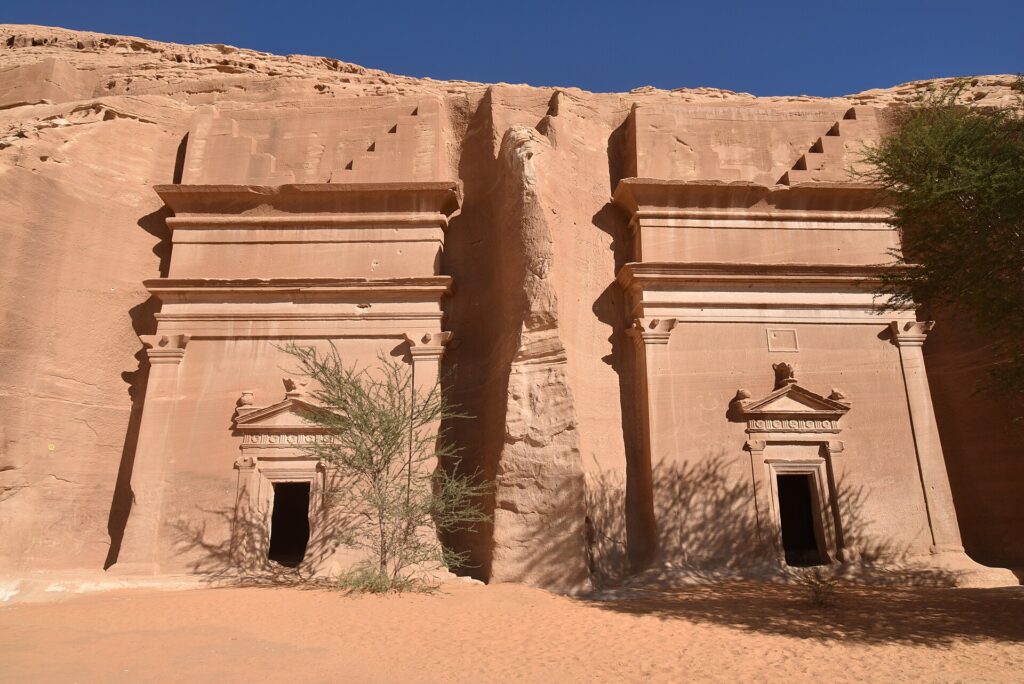
Jabal Banat holds one of the densest concentrations of tombs, with facades bearing eagles, sphinxes and inscriptions that record who was buried and the penalties for tomb robbery. Jabal Ahmar and Jabal Khuraymat round out the tour, each showing a slightly different phase of carving. You will also pass the Handcraft Pavilion, where local artisans demonstrate traditional crafts — a gentler end to the loop before you head back. Seeing these clusters in one guided loop is the reward for planning how to visit Hegra.
Best time to visit Hegra
Timing matters more here than at almost any site I know, because AlUla is a desert and the summer is brutal. Any sensible plan for how to visit Hegra starts with the calendar.
The season runs October to April, when daytime temperatures sit in a comfortable 15–25°C range, skies are clear, and the low winter sun turns the sandstone deep amber and red — the light everyone photographs. This window also overlaps with the Winter at Tantora festival, roughly December to March, which layers concerts, hot air ballooning and cultural events over the ruins. If a sunrise flight over the tombs appeals, our hot air balloon over AlUla guide covers that add-on.
Summer, from June to September, regularly pushes past 40°C. Tours still run, but a midday walk between exposed tombs in that heat is genuinely unpleasant, so book the earliest morning slot if you must visit off-season. Whatever the month, aim for the first departure of the day: cooler air, softer light, and thinner crowds. Season is half of how to visit Hegra well.
| Season | Months | Typical daytime temp | Verdict |
|---|---|---|---|
| Peak | Dec–Mar | 15–25°C | Best light, book early — sells out |
| Shoulder | Oct–Nov, Apr | 20–30°C | Great, quieter |
| Off-season | Jun–Sep | Often 40°C+ | Only early-morning slots |
Practical tips for how to visit Hegra
A few things I wish I had known before working out how to visit Hegra the first time.
- Wear closed shoes and bring a hat. The ground is sandy and uneven, and shade is scarce between tombs. Sunscreen and your own water bottle are worth carrying even though water is provided.
- Arrive 20–30 minutes early. The South Gate is the meeting point and tours leave on time; if you are connecting from Winter Park by coach, build in extra buffer.
- Respect the rules. You must stay on the marked paths and cannot enter the tombs — this protects fragile 2,000-year-old carvings, and guides enforce it. Following it is part of how to visit Hegra responsibly.
- Combine it with the rest of AlUla. Dadan, Jabal Ikmah’s inscriptions, Elephant Rock and AlUla Old Town are all close by. Plan at least two full days; our overview of whether AlUla is worth visiting explains how the sites fit together.
- Dress modestly. Saudi Arabia has relaxed a great deal, but covering shoulders and knees keeps things comfortable and respectful, especially away from the resort bubble.
How to visit Hegra on a budget vs in style
There is no single right way to do this, so here is how to visit Hegra at both ends of the spectrum.
On a budget, the maths is friendly. The Hegra Day Tour from around SAR 95 is the single biggest ticket cost, the site itself is remarkably cheap for what it is, and the real expense is accommodation and flights. Fly into Medina, drive three hours, stay in one of AlUla’s mid-range hotels or the heritage guesthouses, and self-cater where you can. Two nights is enough to see the headline sites without rushing, and it is the lean version of how to visit Hegra.
In style, AlUla delivers. The Premium 4×4 tour, a stay at a luxury desert resort, a hot air balloon at dawn and a dinner at Maraya, the mirrored concert hall, turn a heritage visit into a full experience. It is not cheap, but it is a different category of trip. Most travellers, myself included, land somewhere in the middle: standard tour, comfortable hotel, one splurge. Wherever you land, how to visit Hegra rewards a little planning.
A quick recap: how to visit Hegra
To pull it together, here is how to visit Hegra in one breath. Book a Hegra Day Tour in advance on Experience AlUla, from around SAR 95. Get to AlUla by flying into ULH or driving from Medina, Jeddah or Riyadh.
Turn up at the Hegra South Gate at your slot, and let the official guide and coach do the rest — no self-driving inside. Go between October and April, take the earliest morning departure, and give yourself a couple of days for the wider AlUla area. Do that and how to visit Hegra stops being a logistics puzzle and becomes what it should be: one of the most memorable mornings you will spend in Saudi Arabia.
Frequently asked questions
Can you visit Hegra without a tour?
No. Hegra can only be seen on an official guided tour booked through Experience AlUla, and self-driving inside the site is not allowed. The whole model of how to visit Hegra is built around timed, guided departures from the South Gate, so a booked slot is essential.
How much does it cost to visit Hegra?
The standard Hegra Day Tour starts from around SAR 95 per person, while the private Premium 4×4 tour starts from around SAR 1,000 per vehicle for up to seven people. Children four and under are free. These are starting prices at the time of writing, so confirm on the official site before you plan how to visit Hegra.
How long do you need at Hegra?
The Day Tour runs about three hours including transfers, and the Premium Tour around two. For the wider AlUla area — Hegra plus Dadan, Elephant Rock and the Old Town — plan at least two full days. Factoring the wider area into how to visit Hegra means booking at least two nights.
What is the best month to visit Hegra?
Between October and April, with December to March the peak for cool 15–25°C days and the Winter at Tantora festival. Avoid June to September, when temperatures regularly exceed 40°C. Book the earliest morning departure whenever you go — timing is a big part of how to visit Hegra well.
Is Hegra the same as Madain Salih?
Yes. Hegra is the historic Nabataean name, and Madain Salih is the Arabic name used locally; they refer to the same UNESCO World Heritage Site north of AlUla. Knowing both names helps when you research how to visit Hegra online.